Maslow and Bloom’s Hierarchy
Maslow’s hierarchy of needs is a tier of five categories of human needs. This is shown in a pyramid model (shown below). The needs that are shown towards the bottom are necessary to be satisfied before satisfying the upper levels according to Maslow in 1943. In order from bottom to top they are:
Physiological- air, food, water, shelter, clothes
Safety- law, stability, protection
Love & belonging- intimacy, trust, care, affection
Esteem- dignity, independence
Self-actualization- self-fulfillment, seeking personal growth
Although Maslow said the lower levels must be accomplished first, he also clarified that it is not necessary that it be 100% satisfied before moving on. It is not an “all-or-none” deal. Once one tier has been “completed” or at least worked on a good amount, it goes away and the next tier becomes the one to focus on. Maslow explained this well with an example: “It is quite true that man lives by bread alone—when there is no bread. But what happens to man’s desires when there is plenty of bread and when his belly is chronically filled?” In other words, of course we will be satisfied with the bare minimum when that is all we have and need, but when we are satisfied, full, and have resources, we will crave more and more. In an article from Simply Psychology explaining the hierarchy, they claim that “Growth needs do not stem from a lack of something, but rather from a desire to grow as a person.”

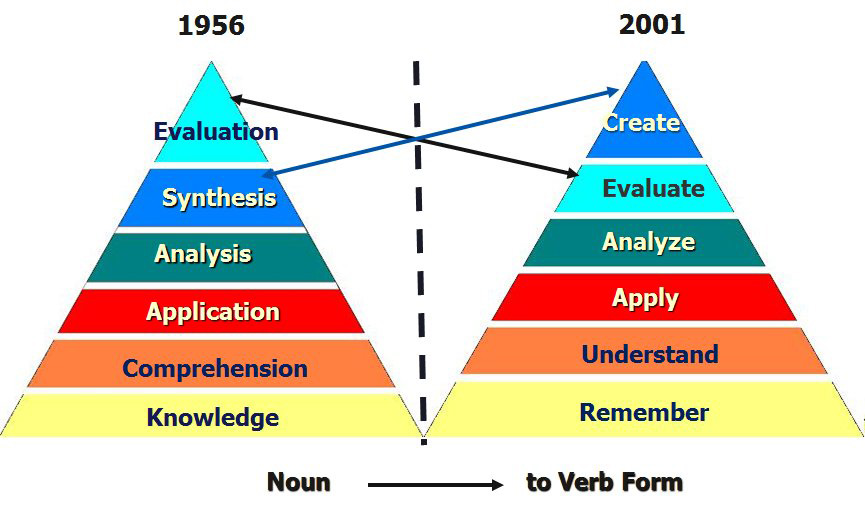
Created by Benjamin Bloom in 1956, Bloom’s taxonomy is a hierarchy that deals with the levels of cognitive skills used by teachers to help their students learn in the classroom. The first version of his pyramid, in order from top to bottom, goes in this order:
Evaluation, Synthesis, Analysis, Application, Comprehension, Knowledge
This was revised in 2001 from nouns to verbs as a way to better understand specific goals. This new version is actually used in classrooms as the teacher’s way to evaluate student understanding on lessons. This new version goes from top to bottom in this order:
Create, Evaluate, Analyze, Apply, Understand, Remember
 Caylee's Blog